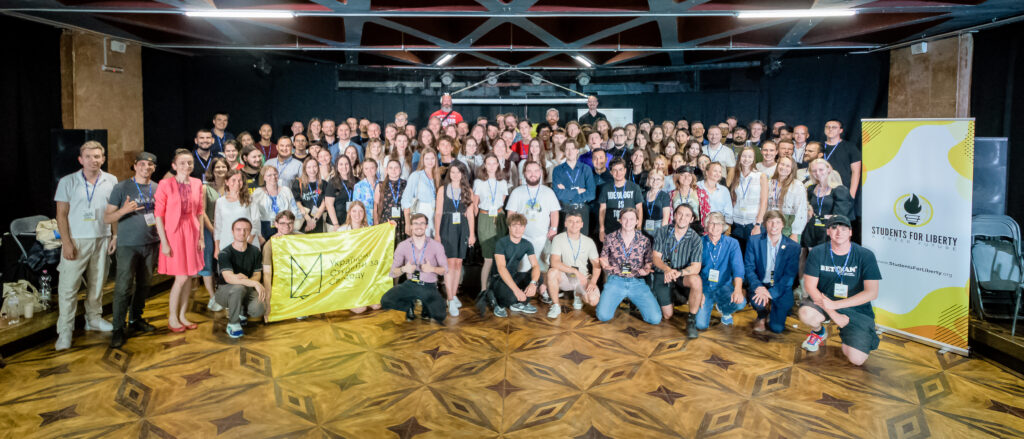
The story of Ukrainian Renaissance is almost too crazy to believe.
In the summer of 2023, in the city of Ivano-Frankivsk, our Czech volunteer and Student of the Year nominee Štěpán Kovář organized a partnership with a local private hospital that had started treating wounded Ukrainian soldiers. It led to the development of Ukrainian Renaissance, a weekend-long event hosted in that city to remind Ukrainians that free-market entrepreneurship is the best defense against an invader … and, more broadly, that the ideas of freedom can give them reason for hope.
The space where that event first took place was later damaged when a shot-down Russian missile fell on it. But the event also had outgrown Ivano-Frankivsk, needing a bigger, safer city. And so it moved to Lviv, a city in Western Ukraine about two hours from the Polish border, and the birthplace of Ludwig von Mises. Over the weekend of July 4, 2025, the third-annual Ukrainian Renaissance was the biggest, grandest, and most inspiring edition yet.
More than 250 visitors from 27 different countries attended the conference, despite the wartime measures that banned commercial flights and made border crossings long and frustrating. 47 speakers delivered 19 sessions in two languages. Ukrainian sessions were hosted in the upstairs breakout room, while English sessions took place on the main stage in the basement that doubled as a bomb shelter.
But beyond the talks and panels, beyond the facts and figures, were the Students For Liberty from throughout Europe who made it happen … and who gathered in Lviv to learn, deepen their relationships, and strategize about building the liberty movements in their countries. In Lviv was an absolute all-star roster of European Students For Liberty.
There was Aquilino Carrasco Alfaro, the Spanish National Coordinator, who heroically organized flood-relief efforts in Valencia in November of 2024. There was Nino Khvedeliani, the National Coordinator from Georgia, whose fundraising campaign delivered badly needed protective gear to protesters and desperately needed funds to help people who were being unlawfully prosecuted and jailed, and their family members. There was Jack Hare, one of SFL’s UK trained volunteers, who had done his part to help Nino from abroad, tirelessly writing to British Members of Parliament about the ongoing political crisis in Georgia. His efforts led directly to a proposed parliamentary investigation into Imedi TV, a pro-Russian propaganda tool. There was the above-mentioned Štěpán Kovář, fresh off his solo, main-stage presentation at BTC Prague, Europe’s biggest Bitcoin event.
And there was so much more in Lviv. There was the Studio Liberty workshop, where students learned how to use social media to their advantage. At one point during the workshop, held in a conference room at the George Hotel, they were given 30 minutes to produce short videos about liberty designed to go viral. The hotel’s “Do Not Disturb” sign featured prominently in one student’s breakdown of the five most important libertarian concepts.
There was also the Difficult Dialogues Colloquium, sponsored by the Atlas Network, in which students used the Socratic method to debate two topics: whether major powers, like the US or NATO, should adopt a more interventionist or more non-interventionist approach; and whether the EU has overall contributed to or impeded economic and individual freedom. These dialogues created a rare space for civil disagreement, critical thinking, and meaningful engagement across diverse viewpoints.
And, of course, there was food, laughter, economic data in abundance, all happening in the midst of the ever-present threat of Russian missiles (including two air raid sirens). But, more than anything, there was hope for Ukraine, for Europe, for liberty. Because Ukrainian Renaissance proved that if you can gather like this in a Ukraine under fire, you can do it anywhere.