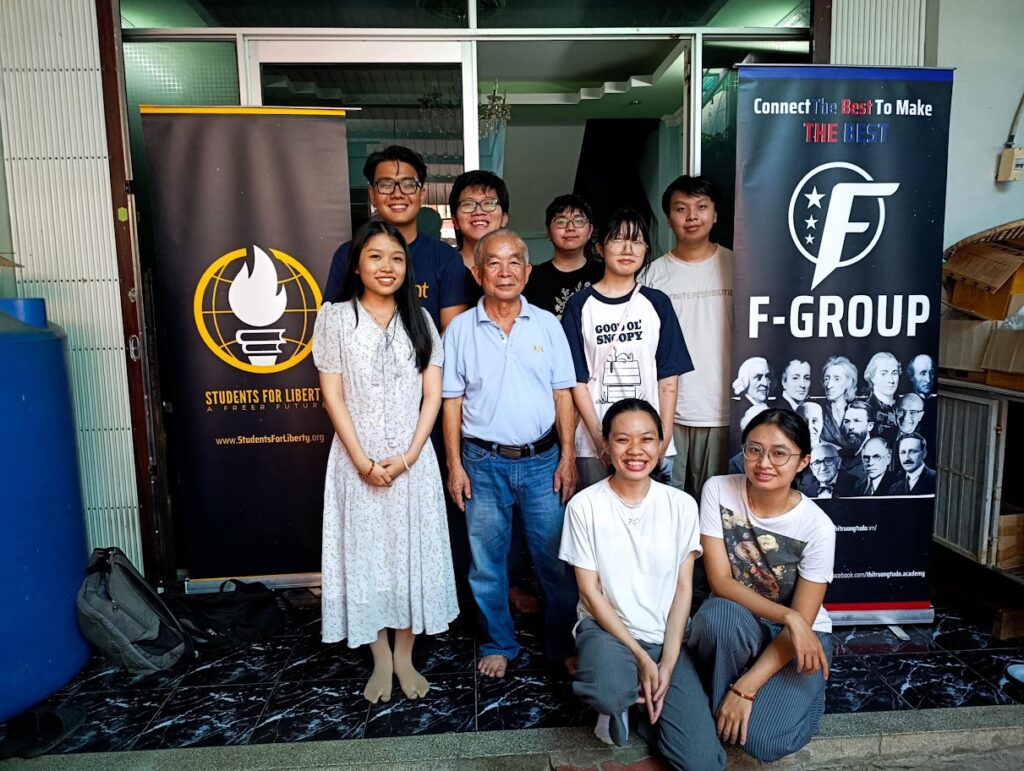
“VIETNAM AND CAMBODIA!?” said one Students For Liberty staffer. “Are you kidding!?”
We were not. Finally, 50 years after the Khmer Rouge’s genocidal reign of terror in Cambodia, there’s hope for the young people of that nation … and it’s because of Students For Liberty.
For 50 years, young Cambodians have had no choice but to live on autopilot, letting everyone else — including the government and their parents — direct the paths of their lives. In particular, students have been discouraged from studying politics or law due to the ever-present belief that people should be subservient to the government, instead of the other way around.
But SFL’s trained volunteer Nhim Chhouby had had enough. “I am so sick of the words ‘government [is] always right,’” she said. And with the backing of Students For Liberty, she did something about it.
The event she hosted was the start of something big, but it started in earnest because of the political climate in Cambodia; the ideas of liberty cannot be spoken about openly. Free markets? Capitalism? Individuality? Forget about it. When Nhim first pitched the event to the principal of the high school where she wanted to host the event, she was told no.
Instead, she and her team pitched a scholarship session to guide high-school students through the application process. “But in each question of our panel discussion, we asked deep questions to challenge their thinking about the state,” she said.
Meanwhile, Vietnam has always been SFL’s white whale: a critical country in which to expand the ideas of freedom, but an ever-challenging environment where non-profits and student activists are often viewed as threats. SFL’s first in-person event there, on February 19, 2025, was executed safely as a test run, and a second event, five days later, focused on entrepreneurship for women. The hosts had to avoid terms like “capitalism” and were reluctant to use SFL branding because of the university’s hostility toward our values. Nonetheless, the events took place and had a profound impact on the students present.
On that note, the Asia-Pacific region also launched the first Women For Liberty Retreat in Bali, Indonesia, involving 13 trained volunteers from four countries (the Philippines, Cambodia, Indonesia, and Vietnam). This Atlas Network-supported project educated female coordinators on how economic liberty can empower women and change the narrative about capitalism in feminist circles — a critical initiative given that 58% of Asia-Pacific volunteers are female. The Women For Liberty program empowered our Asia-Pacific coordinators to organize a total of 34 WFL events in five countries, attracting 847 students. Additionally, the program’s reach was expanded through the publication of 11 short educational videos on social media, which garnered 5,560 views. These results doubled the goals we promised to the Atlas Network!
Oh, and let’s not forget Indonesia, where, as our National Coordinator, Iman Amurillah said, “I’m afraid every day of violence from local thugs and radical Islamic organizations, and our government is growing more authoritarian day by day. We risk being jailed because of our criticism of government, or ‘blasphemy’ since liberalism is considered such in our religious society. But, being silent means we would just give them the chance to be more dangerous without any obstacles.”
And so Iman has sprung into action. He hosted an event during Pride Month in June that gathered more than 200 people for sessions not just about LGBTQ rights, but more broadly about the importance of freedom and why government should not get to determine how individuals define themselves.
Iman also ran an event called Sustainable Business for Green Entrepreneurship, where he and his Indonesian team collaborated with the Department of International Relations at the University of Amikom-Yogyakarta. This event hosted more than 200 students to discuss how free markets can support environmentalism by practicing regenerative farming and green business.
The event included three speakers from different backgrounds: first, the director of a local startup focused on solving food waste, who exemplified how free markets innovate and make life better; the director of an NGO, who spoke about the trade-offs of an organic lifestyle; and a lecturer who discussed how the international community should take part in the efforts to mitigate climate change. At the end, participants joined a group discussion about how the rapid development of the technology sector can help make the environment healthier.