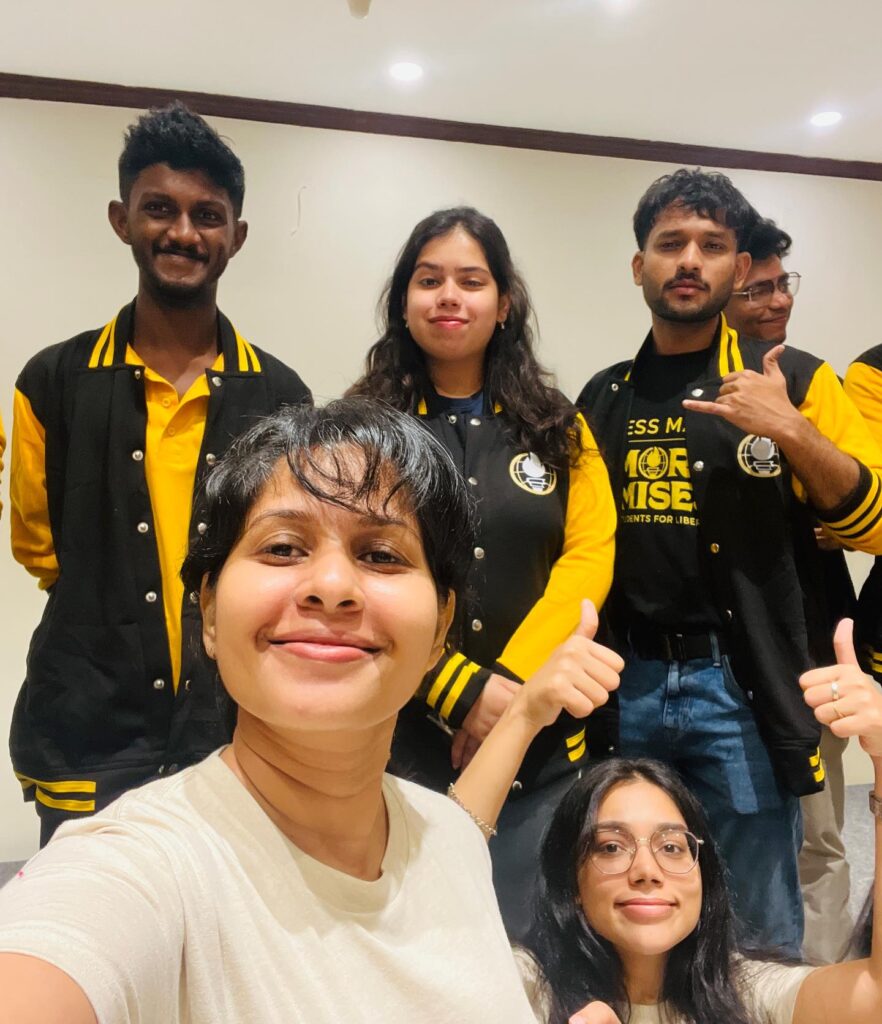
On July 13, 2022, Namini Panditha was a freshly minted SFL alumnus in Sri Lanka, had just started her career as an attorney, and just days earlier had founded the Liberal Youth Movement (LYM) — an independent, youth-led initiative dedicated to defending liberty, rule of law, individual dignity, and democratic accountability.
But Sri Lanka was in the midst of its most severe economic and political crisis in decades, racked by protests, and stomped on by the heavy-handed government crackdown on them.
Namini knew she had to step up to the plate. Students For Liberty had taught her not to shy away from challenges, but to rise to meet them. SFL had taught her how to do so in a professional way. And through years of training, it had instilled the confidence in her that she could — even though she was a woman in a male-dominated space. Even though her voice was a lone liberal voice in a sea of statist voices.
And so, Namini, on behalf of LYM, filed her first petition in court; it challenged the emergency regulations the acting president had executed to suppress citizen protests. Namini argued that these regulations violated key constitutional guarantees such as equality before the law (Article 12); the freedom from arbitrary arrest (Article 13); and freedom of expression and assembly (Article 14).
Although the fight took three years, and although Namini suffered a brutal onslaught of negativity (more on that below), she knew she could withstand it all. She knew she could because she had behind her a network of thousands of supporters, friends, and colleagues across 117 countries worldwide. Namini knew she had Students For Liberty behind her.
On July 23, 2025, a majority of the three-judge bench ruled that the emergency regulations violated the Constitution. In ruling in favor of the petitioners, the Court declared the regulations unconstitutional and ordered the government to pay legal costs.
“This was never just about a legal victory,” Namini said. “It was about setting a national precedent — that when rights are violated, we respond not with violence, but with reasoned, principled legal action. We chose the courtroom — not chaos — as our battleground.”
“The Supreme Court’s judgment now sets a critical precedent,” she continued. “No leader can arbitrarily invoke emergency powers to silence dissent. For us, it’s a victory for freedom — not just in Sri Lanka, but for every young activist who believes in liberty and the power of peaceful resistance.”
Indeed, Namini’s effort sets an example for what can be done, even by regular people in Sri Lanka, where, under the British Common Law system, any constitutional violation by the State can be challenged by anyone in the public. That is, if they have the courage of their convictions — the philosophical underpinning and education to know that what they’re fighting for is just — and a system of driven, like-minded friends and colleagues for emotional and legal support.
That’s exactly what Namini has in Students For Liberty. As she said to SFL’s South Asia Programs Manager, “Thank you — as someone who’s been a real mentor and friend throughout this journey. Your encouragement, honest advice, and belief in what we do have meant more to me than words can express.”
No one can do it alone, and throughout the process, Namini needed as much encouragement and belief as she could get.
“It was an intense mix of emotions,” she said. “I had to endure a lot of pressure and negativity. At times, the hate and targeted comments broke me mentally. I was even threatened by several people to stop my work.”
But for Namini, the work never stops — and it certainly doesn’t stop here.
“My very first feeling when I heard the case was won was not excitement, but the question: How are we going to communicate this to the public? I was thinking about how to explain and elaborate the classical liberal values we tried to uphold when filing the case, rather than letting it be turned into a political tool,” she said. “Even though we had no political motive, our sole aim was to defend values like the rule of law, individual rights, and peaceful dissent.”