Over the past six years, the African Liberty Writing Fellowship has had more than 7,000 young Africans apply for the program, from every country on the continent. But the ALWF is exclusive; it accepts and trains only the very best: 382 trained in public policy analysis and opinion editorial writing since 2019. And 134 of these trainees graduated as writing fellows after completing the 12-month program. Those alumni have gone on to work in embassies, as special assistants to governors, and as reporters for top global news outlets like Agence France-Presse. The program has received endorsements from reputable organizations like the Association of Foreign Correspondents in the USA and the International Center for Journalists.
These rising thought-leaders, and those who will follow in their footsteps, learned not only how to build an argument from the ideals and economics of free markets and liberty, but they also learned how to build a platform. After intensive training, their final assignment was to write an opinion-editorial, and the fellowship’s staff helped fellows pitch articles to mainstream outlets.
David Adetula of Nigeria is just one of many success stories from the Fellowship (more below). He completed the program, became an editor for it, and is now saying goodbye — with the program in an even better place than he found it.
“Prior to the fellowship,” he said, “I knew how to write and had written a few things in school, but, trust me, what I really knew about writing was near zero. My journey has been characterized by massive learning — my writing and editorial skills have grown tremendously — but not just from my fellow editors and editor-in-chief. I’ve also learned from the fellows I train; more than 30 over the past three years, on pitching an idea for writing, factually developing and making compelling arguments in an article, and ensuring every element of a good op-ed is present in an article.”
You read that right. Not only has David become a successful writer himself, but he also mentored dozens of writers to follow in his footsteps.
David’s first article appeared in the Ugandan Monitor — Uganda’s biggest daily paper — and he went on to publish 7 more articles on free-market health policy, while in dental school. One of his articles analyzed a law in Nigeria that empowered caretakers of people with mental health issues to mistreat them. Shortly after his article appeared, the law was repealed.
Other graduates of the Fellowship program include:
- Ope Adetayo, who currently serves as the Associated Press’s West Africa correspondent.
- Ibraheem Abdul Lateef, who was appointed Special Assistant to the Governor of the state of Kwara in Nigeria, and specializes in communications.
- Bishoy Sadek, who was appointed by the President of Egypt as a diplomatic attaché for the Egyptian Ministry of Foreign Affairs.
- Ephraim Modise covers Southern Africa for TechCaba, a popular African innovation and technology publication.
- Temitayo Akinyemi, who recently was presented the award for Best Journalist by the Media Foundation for West Africa.
These writers and many others from the network the fellowship has built are directly responsible for the intellectual footprint — and foothold — the ideas of liberty are creating throughout Africa. And the momentum is spreading throughout the continent; SFLers are publishing excellent content at an astonishing pace.
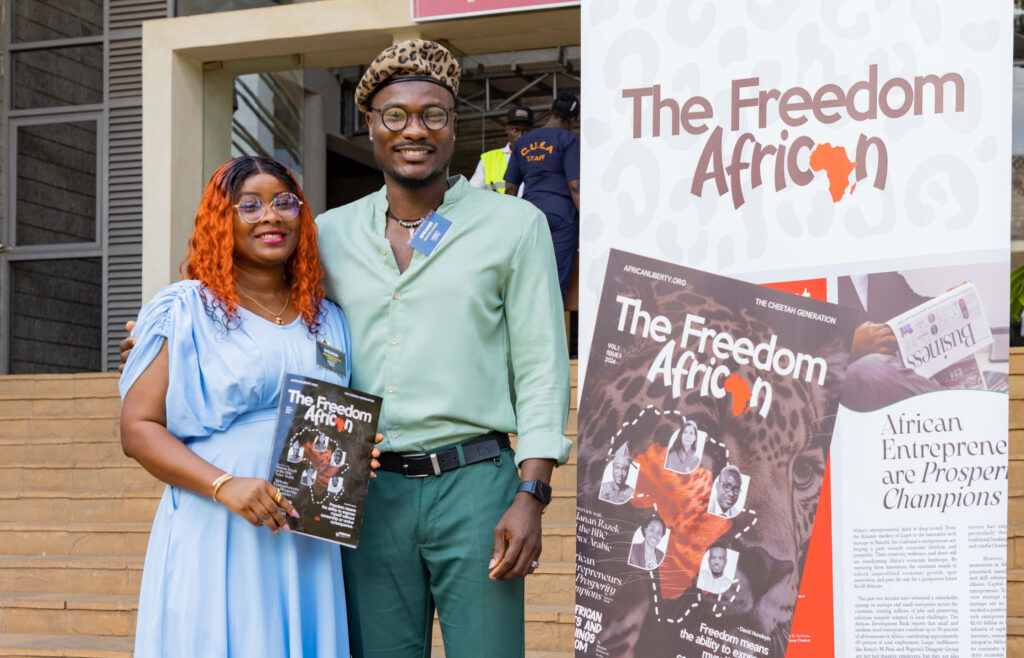
The publication of Igniting Liberty Magazine – Africa Edition marked a milestone in the region’s evolution. Compiled by regional leaders and contributors, the magazine included student essays, profiles of successful African alumni, and feature articles on African classical liberal thinkers.
Alongside the magazine, SFL’s Africa team produced a powerful collection of policy essays and training materials, some of which were distributed at regional retreats and conferences. These included: a free-market policy guidebook tailored for African youth navigating economic challenges; curriculum materials for the Cheetah Generation Program, emphasizing trade, entrepreneurship, and local governance; and multiple student-written essays published via the Learn Liberty digital platform. Most recently, African Liberty Magazine published its first book in more than a decade. It’s called The Future of Democracy in Africa.
SFL Africa’s network of writers quickly expanded beyond the written word, precisely according to SFL’s roadmap for social change: Several of our fellows appeared on some of the most respected TV cable news stations on the continent to offer their analysis on the recent elections in Ghana and Namibia. These TV appearances reached 20 million viewers! We already dominate the newspaper space on the continent; the TV space is our next agenda, and the results of the last two months suggest we’re on the right path.